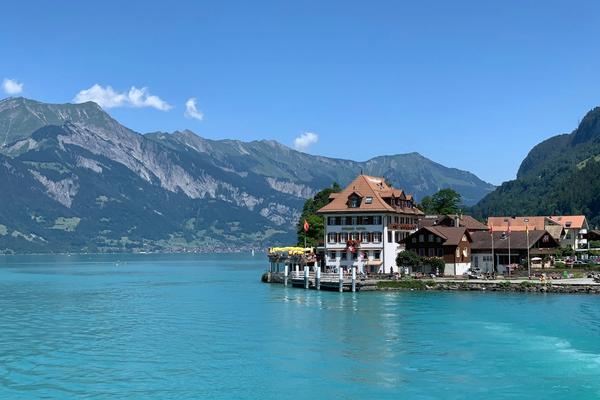

Geneva sits where the Rhône leaves Lake Geneva, framed by water, parks and distant Alpine peaks. Its international reputation is larger than its physical scale: global institutions, private banks and watchmaking houses share a compact city with neighbourhood markets, public beaches and an old town that can be explored comfortably on foot. The Jet d’Eau provides the unmistakable landmark, rising from the harbour beside lakeside promenades and the English Garden.
The Old Town climbs above the left bank through cobbled passages, historic façades and small squares. St Peter’s Cathedral stands at its centre, closely associated with Geneva’s role in the Protestant Reformation, while the nearby Reformation Wall places that history within a broader European story. Maison Tavel and the Museum of Art and History add depth for travellers who want to understand the city beyond its polished lakefront image.
Across the lake, the Nations district reflects Geneva’s modern identity as a centre for international cooperation. The Palais des Nations, the International Red Cross and Red Crescent Museum and the surrounding diplomatic quarter reveal how closely the city is tied to humanitarian work and multilateral politics. CERN, outside the centre, offers another dimension through exhibitions devoted to particle physics and the study of the universe.
Geneva is also unusually practical for Muslim travellers by Swiss standards. Established mosques and Islamic centres serve the city, while halal Lebanese, Pakistani and North African restaurants are concentrated around Les Pâquis, Cornavin and neighbouring districts. Lake cruises, chocolate shops, watchmaking museums and easy rail links to Montreux, Lausanne and the Alps make Geneva useful both as a destination and as the western gateway to a wider Swiss journey.
Best time to visit
May to September for lake cruises, parks and outdoor dining; April and October for fewer visitors; December for festive markets and indoor culture.