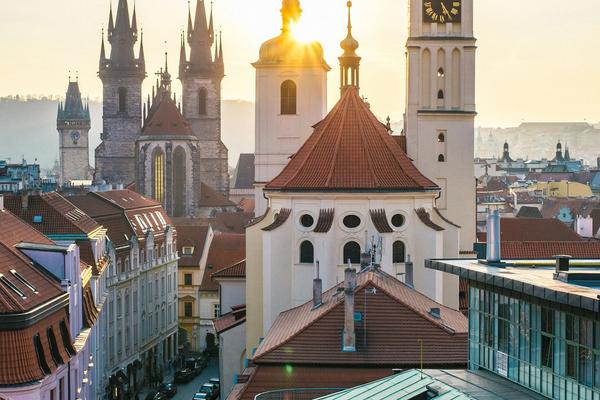

Prague is one of the few major European cities that emerged from the Second World War with its medieval and baroque core largely intact. The result is a city where you can walk from a 14th-century stone bridge to a 10th-century castle and pass Romanesque, Gothic, Renaissance and Art Nouveau buildings in a single afternoon. The old town is compact enough to cover on foot in a day, but layered enough to reward several.
Hradčany hill holds the castle complex — the largest ancient castle in the world by area — with St Vitus Cathedral, the royal palace and the Baroque gardens below the walls. At the base of the hill, the Charles Bridge crosses the Vltava River on 16 sandstone arches, lined with 30 Baroque statues commissioned in the early 18th century. The Old Town Square below the bridge is anchored by the twin Gothic spires of Týn Church and the Astronomical Clock on the town hall tower, which has been marking the hour since 1410.
Wenceslas Square connects the medieval old town to the modern New Town — a boulevard rather than a square, 750 metres long and lined with hotels, theatres and cafes. The city's halal dining options are concentrated in the centre and along the main tourist corridors, and the Jubilee Synagogue in Josefov is one of the largest in Central Europe. Prague rewards slower travel: the lanes of Malá Strana below the castle, the viewpoints above Vinohrady, the covered market halls of the Smíchov neighbourhood — these take longer than the highlights, and they deliver more.
Best time to visit
April to October