


Trace the layered history of Portugal and Spain over nine days, from Lisbon’s maritime heritage and Faro’s Algarve old town to the great cities of Andalusia. Explore Seville’s Moorish and Christian landmarks, enter Córdoba’s extraordinary Mezquita-Catedral, and discover Granada’s Alhambra and Generalife gardens with a local guide. Continue through fortified Toledo before ending with two days in Madrid. The route brings Islamic, Jewish, Christian and Portuguese history into one coherent journey rather than treating each city in isolation. Eight nights’ accommodation, breakfasts, dinners, airport transfers, ground transport, guided touring and tipping are included; international flights are arranged independently. Halal meal planning makes this especially suitable for travellers seeking an Iberian cultural journey with thoughtful logistics.
A Glimpse of Your Journey
- ◆Alhambra & Generalife, Granada — guided tour of Andalusia's Moorish palace complex
- ◆Mezquita-Catedral, Córdoba — the great mosque that became a cathedral
- ◆Alcázar de Sevilla — Moorish royal palace still in use by the Spanish crown
- ◆Belém, Lisbon — where Portugal's Age of Discovery set sail from the Tagus
- ◆Plaza de España, Seville — the most photographed square in Andalusia
- ◆Toledo — Arab, Jewish and Christian monuments in one walled old city
Itinerary & Route
You arrive at Lisbon Humberto Delgado Airport and a private or shared transfer brings you to the hotel. Check-in from 14:00. Lisbon is an immediately walkable city from most central hotels — the Baixa grid, the Alfama hill and the riverside are all within reach if you arrive with energy and an evening to spare.
Airport Transfer — Private or SIC. Your tour leader meets you on arrival.
Note on flights — Flights are not included. Arrange your own arrival into Lisbon (LIS) and departure from Madrid (MAD).
You arrive at Lisbon Humberto Delgado Airport and a private or shared transfer brings you to the hotel. Check-in from 14:00. Lisbon is an immediately walkable city from most central hotels — the Baixa grid, the Alfama hill and the riverside are all within reach if you arrive with energy and an evening to spare.
Airport Transfer — Private or SIC. Your tour leader meets you on arrival.
Note on flights — Flights are not included. Arrange your own arrival into Lisbon (LIS) and departure from Madrid (MAD).
What's Included
- hotel
Accommodation
8 nights in 3★ hotels
- restaurant
Meals
8 breakfasts and 7 dinners
- airport_shuttle
Transport
Return airport transfers and itinerary transport
- tour
Guide
Alhambra local guide and Tour Leader throughout
- local_activity
Activities
Lisbon, Faro, Seville, Granada, Toledo and Madrid tours, plus Generalife entry
- handshake
Tips
Guide and driver tipping included
Dates & Prices
Pricing coming soon
Season pricing for this route hasn't been published yet. Enquire and we'll get you a quote, or ask to be notified once it's live.
Frequently Asked Questions

Iberian Historia: Lisbon, Seville, Granada
Trace the layered history of Portugal and Spain over nine days, from Lisbon’s maritime heritage and Faro’s Algarve old town to the great cities of Andalusia. Explore Seville’s Moorish and Christian landmarks, enter Córdoba’s extraordinary Mezquita-Catedral, and discover Granada’s Alhambra and Generalife gardens with a local guide. Continue through fortified Toledo before ending with two days in Madrid. The route brings Islamic, Jewish, Christian and Portuguese history into one coherent journey rather than treating each city in isolation. Eight nights’ accommodation, breakfasts, dinners, airport transfers, ground transport, guided touring and tipping are included; international flights are arranged independently. Halal meal planning makes this especially suitable for travellers seeking an Iberian cultural journey with thoughtful logistics.
You arrive at Lisbon Humberto Delgado Airport and a private or shared transfer brings you to the hotel. Check-in from 14:00. Lisbon is an immediately walkable city from most central hotels — the Baixa grid, the Alfama hill and the riverside are all within reach if you arrive with energy and an evening to spare.
Airport Transfer — Private or SIC. Your tour leader meets you on arrival.
Note on flights — Flights are not included. Arrange your own arrival into Lisbon (LIS) and departure from Madrid (MAD).
Lisbon is built on seven hills and oriented toward the Tagus River — and the orientation today covers three of its most distinct districts. Belém is where it all began: the shipyards and docks on the river from which 15th-century Portuguese explorers charted the sea routes to East Africa, India and Brazil. The wealth those routes brought back is visible in the Manueline stonework of the Jerónimos Monastery and the Torre de Belém on the riverbank.
Belém District — The riverside suburb where the Age of Discovery launched. Photo stops at the Jerónimos Monastery exterior and the Torre de Belém; interior entry requires separate tickets not included in the tour.
Alfama District — The oldest quarter of Lisbon, built up the hillside below the São Jorge Castle. The narrow lanes are best explored on foot. Photo stop.
Baixa District — The commercial heart of Lisbon, rebuilt in strict neoclassical style after 1755. The Praça do Comércio opens onto the Tagus at the southern end.
Liberdade Shopping District — Free time on and around Avenida da Liberdade, Lisbon's main boulevard.
Lisbon Central Mosque — Prayer time at the central mosque.
A driving day that moves from Portugal into Spain, with a meaningful stop in Faro on the way. Faro is the capital of the Algarve — a compact walled old town set behind a lagoon, less visited than the beach resorts to the west and better for it. The cobbled streets around the Cathedral of Faro and the Doca harbour take 60–90 minutes at a relaxed pace before the coach crosses the border into Andalusia.
Faro Old Town — The walled historic centre of Faro, accessed through the Arco da Vila. Photo stops at the Doca de Faro and the Cathedral of Faro, built on the site of a former mosque. The old town is compact and walkable; Rua de Santo António provides free browsing time.
Drive to Seville — Approximately 3 hours east across the Algarve and into Andalusia.
Seville is where Moorish and Christian Spain collide most dramatically. The city was the capital of al-Andalus under the Almohad dynasty; when Ferdinand III retook it in 1248, the conquerors kept the mosque's minaret as a cathedral bell tower (the Giralda) and built the Royal Alcázar directly on top of the Moorish palace.
Plaza de España — The semicircular baroque-Moorish plaza built for the 1929 Ibero-American Exposition, with a canal, ceramic-tiled alcoves representing every Spanish province, and a bridge at each end. One of the most photographed public spaces in Spain. Allow 30 minutes.
María Luisa Park — The public park surrounding the Plaza de España, donated to the city by the Infanta María Luisa in 1893. Photo stop.
Golden Tower (Torre del Oro) — The 13th-century Almohad watchtower on the Guadalquivir River. Photo stop from the riverbank.
Real Alcázar (Exterior) — The Moorish royal palace complex, continuously inhabited and expanded from the 10th century to the present.
Seville Cathedral (Exterior) — The largest Gothic cathedral in the world, built on the site of the Almohad Great Mosque. Interior entry requires a separate ticket.
Calle Sierpes — Seville's main commercial pedestrian street. Free browsing time.
Sevilla Mosque Foundation — Prayer time.
Córdoba gets a focused morning on the route east to Granada. It was the capital of the Umayyad Caliphate of Córdoba in the 10th century — at its height the largest city in Western Europe, a centre of Islamic scholarship, philosophy and science. What remains is the Mezquita-Catedral: a mosque begun in 784 on the site of a Visigothic church, expanded over four centuries to become the second largest in the world after Mecca, and then converted into a cathedral after the Christian Reconquista in 1236.
Mezquita-Catedral de Córdoba — Photo stop at the exterior and the Puerta del Puente gate on the Roman Bridge approach. Interior entry requires a separate ticket not included in the tour; the exterior and the bridge are the standard stop. Allow 45–60 minutes.
Roman Bridge (Puente Romano) — The 1st-century bridge across the Guadalquivir, rebuilt in the Moorish period. Photo stop.
Torre de Calahorra — The 14th-century tower at the southern end of the Roman Bridge. Photo stop.
Córdoba Old Town — Brief free time in the Judería (the old Jewish quarter) before continuing to Granada.
Drive to Granada — Approximately 2 hours southeast.
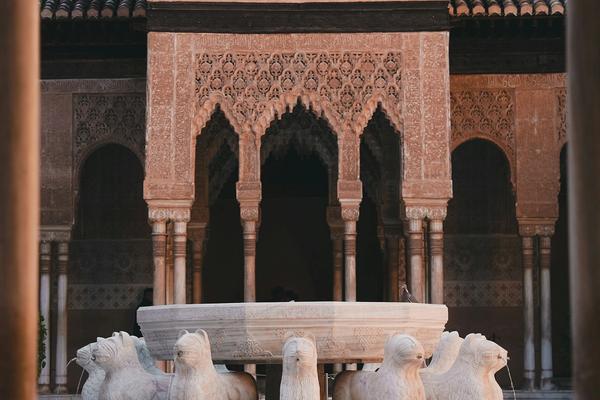
The Alhambra is the reason most people come to Granada, and it earns its reputation. The palatial city built by the Nasrid sultans in the 13th and 14th centuries on the hill above Granada is the finest surviving example of Moorish architecture in the world — not a ruin, not a restoration, but a complex of palace rooms, courtyards, baths and gardens that has been maintained continuously since it was built.
Alhambra Guided Tour — The UNESCO World Heritage palatial complex. Your local guide covers the Palacios Nazaríes (the Nasrid Palaces), the Charles V Palace and the Alcazaba fortress.
Generalife Gardens — The summer palace and gardens of the Nasrid sultans above the Alhambra. Terraced gardens, water channels and the Patio de la Acequia. Included.
Granada Mosque — Prayer time at the mosque on the Albaicín hill, built in 2003 with a view across to the Alhambra.
Mirador de San Nicolás — The hilltop viewpoint in the Albaicín with the most direct panorama of the Alhambra and Sierra Nevada behind it.
Granada City Orientation — Photo stops at Plaza Isabel la Católica, the Alcaicería (the old Moorish silk market), Granada Cathedral and the Madrasah of Granada (the former Islamic university).
Toledo sits on a granite hill almost entirely encircled by the Tagus River — a natural fortress that made it the capital of Visigothic Spain, then a major city of Islamic al-Andalus, then the imperial capital of Charles V. The UNESCO-listed walled old city holds Arab, Jewish and Christian monuments within a few hundred metres of each other: a mosque, a synagogue, a cathedral, and a castle, all from different eras and all still standing. A focused 90-minute stop covers the main viewpoints before the coach continues to Madrid.
Mirador Toledo — The panoramic viewpoint from the south bank of the Tagus, giving the full silhouette of the walled city on its hill. The best photograph of Toledo is taken from here.
Alcázar de Toledo — The 16th-century fortress on the city's highest point, rebuilt after near-total destruction in the Spanish Civil War. Photo stop.
Toledo Cathedral — One of the great Gothic cathedrals of Spain, built over 270 years from 1226. Photo stop from the Plaza Mayor.
Continue to Madrid — Approximately 75 minutes north. Free time at El Rastro area on arrival.
Madrid is Spain's capital and youngest major city — it only became the permanent seat of the Spanish crown in 1561 — which gives it a different energy to Seville, Granada and Toledo.
Santiago Bernabéu Stadium — The 81,000-seat home of Real Madrid, second largest stadium in Spain. Photo stop from the exterior plaza.
Temple of Debod — A genuine 2nd-century BC Egyptian temple, dismantled and gifted to Spain in 1968 in recognition of Spanish archaeologists' work in Nubia. Stands in a park above the Manzanares River.
Plaza de España — Madrid's large public square at the western end of Gran Vía.
Royal Palace of Madrid (Palacio Real) — The official residence of the Spanish royal family, though not used as a primary residence.
Almudena Cathedral — Built over 110 years and completed in 1993, directly adjacent to the Royal Palace. Photo stop.
Plaza Mayor — The grand 17th-century square at the centre of Habsburg Madrid, surrounded by uniform arcaded buildings. Photo stop.
Puerta del Sol — The symbolic centre of Madrid and all of Spain (kilometre zero for the country's road network). Free time in the surrounding streets.
Galería Canalejas — A 19th-century block converted into a luxury shopping gallery with international brands. Included.
After breakfast, check out and a private or shared transfer takes you to Madrid Barajas Airport (MAD) for your departure flight. The tour ends at the airport. Nine days, seven cities, two countries, one great mosque, one palatial Moorish complex, and a cathedral built on top of a minaret.
What's Included
- ✓8 nights accommodation at 3-star hotels
- ✓8 daily breakfasts at hotels
- ✓7 dinners at restaurant or hotel
- ✓Private or SIC return airport transfers
- ✓Transportation as per itinerary
- ✓English-speaking local guide for Alhambra guided tour
- ✓Orientation tours by Tour Leader in Lisbon, Faro, Seville, Granada, Toledo and Madrid
- ✓Generalife entrance fee
- ✓Galería Canalejas visit
- ✓Tipping for guide and driver
- ✓City and tourist taxes
- ✓Tour Leader throughout
- –Air ticket (unless stated as included)
- –Travelling visa
- –Dinner on first and last day
- –Lunch daily
- –Personal and travel insurance
- –Attraction entrance fees (unless stated as included)
- –Porterage
- –Personal expenses


