
Venice was built on 118 islands in a shallow lagoon on the northern Adriatic coast — a deliberate choice made by refugees from the Roman cities of the Veneto who sought a defensible location the Lombard and Hun invaders could not easily reach. What began as a refuge became, by the 13th century, the dominant maritime trading power in the Mediterranean: the Republic of Venice controlled the spice routes from the East, the glassblowing industry relocated to Murano in 1291 to protect the city from fire, and the Doge’s Palace was the seat of a government that ran continuously for over a thousand years. The republic ended in 1797 when Napoleon took the city without a fight. The canals and the palaces remained.
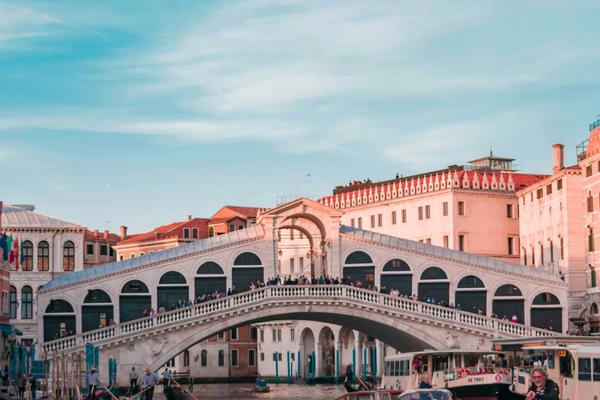
The city is reached from the mainland at Mestre by water taxi or the vaporetto — the public waterbus that is the functional equivalent of a city bus network, running on the Grand Canal and the routes between the islands. San Marco is the formal centre: the Piazza, St Mark’s Basilica with its five Byzantine domes and 8,000 square metres of gold mosaic, the Campanile, the Torre dell’Orologio and the Doge’s Palace on the southern edge of the square. The Rialto Bridge, three minutes’ walk north, is the oldest of the four Grand Canal crossings and the best elevated view of the water. Murano, a short vaporetto ride northeast, has been producing glass since the glassblowers were relocated there in 1291 — the factories are open to visitors and the demonstrations are genuine.
Halal dining options in Venice are limited — the city is small and the restaurant scene is predominantly Italian and tourist-facing. The Mestre mainland has more options and is where most group tours overnight. Venice is best visited in the shoulder seasons: April to June and September to October give the most manageable crowd levels and the best light. July and August are hot and extremely crowded; November to January is quiet but frequently foggy and prone to acqua alta (the periodic tidal flooding that can cover the lower parts of the city by 30–60cm). The gondola is worth taking once — for the back canal routes that the vaporetto cannot reach rather than the Grand Canal, which is faster by waterbus.
Best time to visit
April to June, September to October