

The Rome-to-Barcelona corridor is one of the most travelled routes in Europe. It is also one of the most badly paced. Most group itineraries cram in too many cities, compensate with marathon driving days, and arrive at each destination just long enough to take photographs before moving on.
Done well, this route is genuinely one of the great European journeys. Done badly, it is an expensive way to collect passport stamps.
The case for two nights in Rome
Rome is not a one-day city. It never has been. The Colosseum and the Vatican are each a half-day commitment done properly — and doing both on the same day, which most itineraries attempt, leaves no room for the city itself.
The Iconic Coasts & Capitals itinerary gives Rome two nights. Day one is a deliberate evening arrival — no museums, no structured tour. Just the Trevi Fountain and the Spanish Steps while both are lit and relatively uncrowded. It is a better introduction to Rome than any guided lecture, and it sets a pace the rest of the trip follows.
Day two covers the Colosseum, the Roman Forum, the Vatican Museums, the Sistine Chapel, and St. Peter's Basilica — all with skip-the-line access and a private guide. It is a full and tiring day. The free evening at Piazza Navona is not padding; it is necessary recovery before Florence.
The Cinque Terre question
Every Europe itinerary at this price point claims to include Cinque Terre. The difference is how.
The standard approach is a coach stop: drive to one village, photograph the cliffs, return to the coach, continue. The result is a thirty-minute visit to a place that deserves a morning.
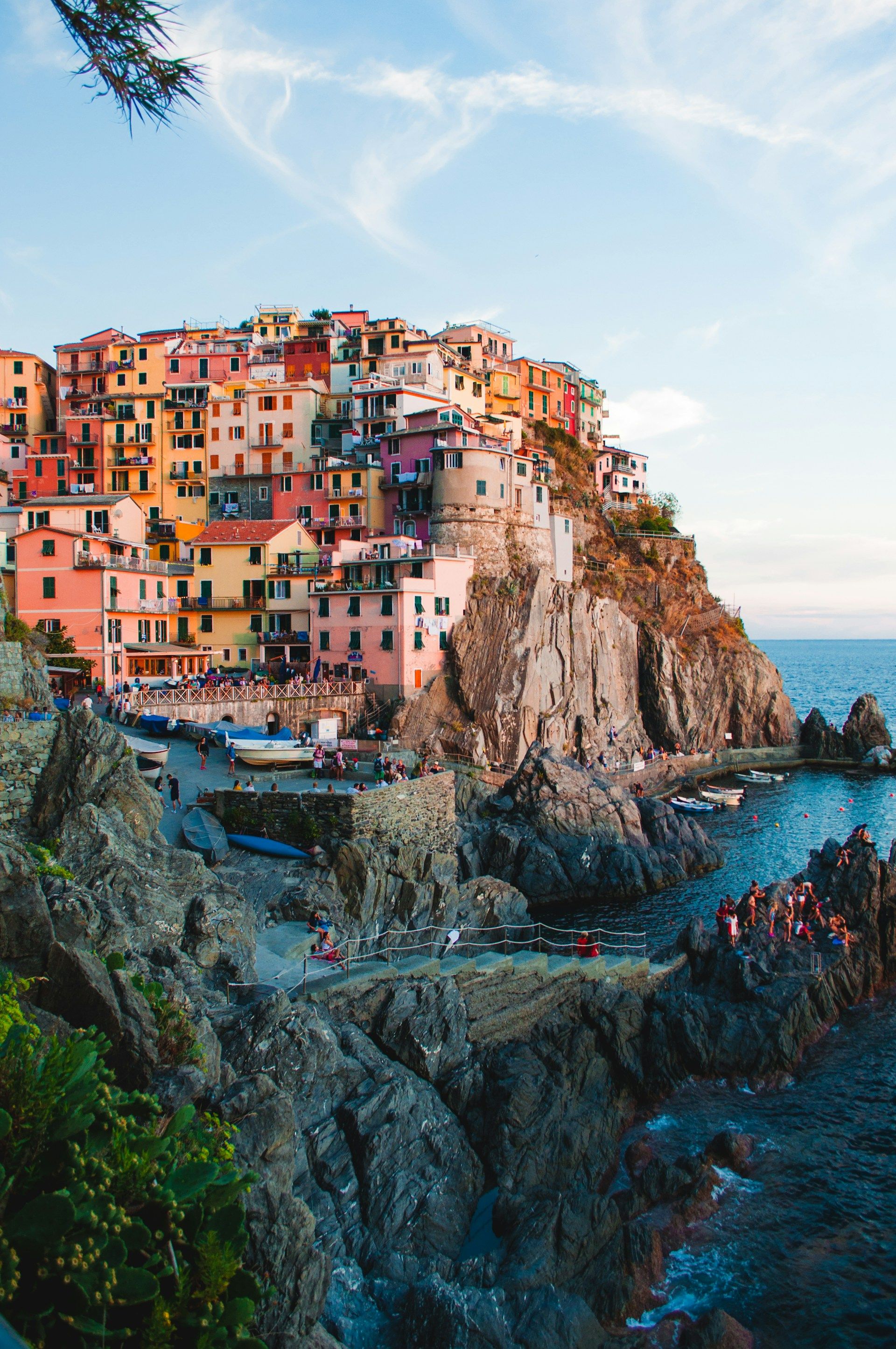
This itinerary approaches it differently. The group leaves luggage on the coach, walks to La Spezia Centrale, and boards the Cinque Terre Express — the local train that connects all five villages. Riomaggiore, Manarola, Monterosso. You stay as long as you like in each, move on when you are ready, and meet the coach at Levanto at 16:00. The coach, meanwhile, has driven ahead with all luggage.
It requires more logistics to plan. It is significantly better to experience.
Two nights in Nice — and why it matters
Nice is the base for one of the strongest days on the itinerary: the Monaco and Èze excursion. The coach takes the cliffside Corniche road to Èze first — a medieval hilltop village at 427 metres with near-vertical sea views and a French perfumery worth twenty minutes of your time — before descending into Monaco for the harbour, the Prince's Palace, and Monte Carlo.
The reason two nights in Nice matters: this day requires no packing. No checkout, no luggage, no hotel change. You return to the same room in the evening. After five consecutive travel days, that detail is worth more than it sounds.
The stop most itineraries skip
Nîmes does not appear on most comparable itineraries. It adds a stop, and stops cost time. The Arena of Nîmes is the best-preserved Roman amphitheatre in the world — structurally more intact than the Colosseum — and most groups never see it because the routing math does not favour it.
Alongside it, the Maison Carrée — a near-perfect first-century Roman temple that influenced the design of the Virginia State Capitol — takes twenty minutes and is one of the most quietly impressive things on the entire route. A local guide covers both.
The stop from Nice to Montpellier via Nîmes adds roughly two hours to the driving day. It is the right call.
Girona before Barcelona
Girona is not a compromise on the way to Barcelona. The colourful hanging houses over the Onyar River are immediately recognisable; the medieval old town behind them rewards a proper wander. More practically: stopping in Girona for lunch means arriving in Barcelona in the early afternoon rather than the traffic-snarled evening. The group checks in early, walks the Gothic Quarter, and has the first group dinner in the city — settled and oriented before the Gaudí day.
What the pacing actually delivers
Two nights in Rome. Two in Florence. Two in Nice. Two in Barcelona. La Spezia and Montpellier are single-night gateway stops, chosen for their position on the route — not inflated into something they are not.
The longest driving leg is the 4.5-hour run from Levanto to Nice on Day 5 — and by that point, the group has spent the morning hopping between Cinque Terre villages by train, so sitting down feels earned rather than punishing. Every other driving day is broken with a stop that belongs there.
Ten days. Five cities worth spending time in. A route that has been thought through rather than assembled from a list of famous names.
If we you are considering this tour, enquire at nextrip.my. We will walk you through the dates and what the itinerary looks like in practice.
Details for the tour can be found here