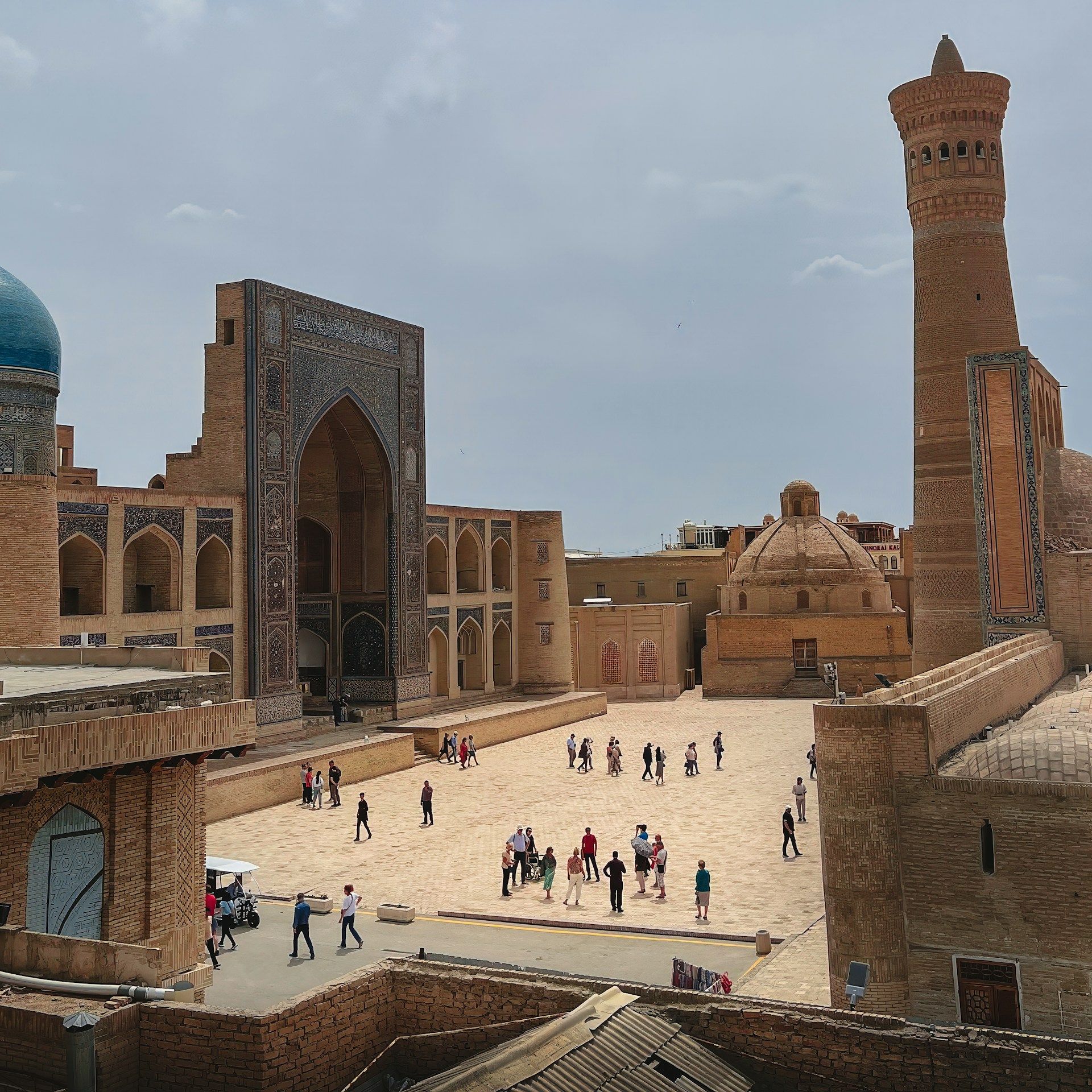

There is a particular kind of travel moment that happens when a place exceeds what you imagined — when the photographs you scrolled past for months turn out to have been underselling it. Registan Square in Samarkand is that kind of place. Three madrasahs, three different rulers, 250 years of construction, and a scale that genuinely stops you when you walk through the gate. Nothing about it reads as a ruin. It reads as a statement.
Uzbekistan is a country most Malaysian travellers have heard of but few have visited. That's changing — and if you're going to go, sooner is better than later.
Three cities, each one worth the trip on its own
The standard Uzbekistan itinerary covers Tashkent, Bukhara and Samarkand — and the standard itinerary happens to be correct. Each city earns its place for different reasons.
Bukhara is the one that surprises people most. It's one of the best-preserved medieval cities in Central Asia — not a heritage district that's been cordoned off and sanitised, but an actual living city where people shop, pray, and go about their days in buildings that are genuinely a thousand years old. The Lyabi Khaus Ensemble, the Trading Domes, the Ark Citadel dating to the 4th century — Bukhara rewards two full days, and most visitors wish they'd had three.
Samarkand is where the ambition becomes visible. This was Timur's capital at the height of his empire — the city he intended to be the greatest in the world. Registan Square is the centrepiece, but Shakhi Zinda Necropolis, a processional avenue of tiled mausoleums in continuous use since the 11th century, is what many travellers remember longest. The tilework is finer than at Registan, and the crowds are thinner.
Tashkent is different from both — a Soviet-era capital rebuilt after a 1966 earthquake, with wide boulevards, monumental plazas, and a metro system decorated with chandeliers and mosaics that justify the stop on their own. The Hazret Imam Ensemble, home to one of the world's oldest Quran manuscripts, sits at the spiritual heart of the city. Chorsu Bazaar, under its large Soviet dome, is where Tashkent actually shops.
Muslim-friendly by default
Uzbekistan is a majority-Muslim country, which means halal food is the default rather than the exception. You won't be negotiating with restaurants or second-guessing menus. The cuisine — plov, lagman, shashlik, samsa — is hearty, distinctive, and available everywhere. It's the kind of food that stays with you after the trip.
Prayer facilities are woven into the fabric of the cities. Many of the most significant sites — the Hazret Imam Ensemble, the Imam Al-Bukhariy Mausoleum outside Samarkand — are active places of worship and pilgrimage. For Muslim travellers, visiting them carries a weight that purely aesthetic tourism rarely does.
Getting around is easier than you think
The Afrosiyob high-speed train connects Tashkent, Samarkand and Bukhara — covering routes that once took most of a day in a few hours. Travelling between the cities by train is genuinely part of the experience: the Uzbek steppe opening up outside the window, the landscape shifting as you move between the ancient and the modern. It's a better way to understand the geography than flying over it.
Direct flights from Kuala Lumpur are available on Uzbekistan Airways. The flying time is roughly seven hours. Uzbekistan is not a difficult country to enter — Malaysian passport holders can visit visa-free for up to 30 days.
Go before everyone else does
Uzbekistan's tourism infrastructure has improved substantially in the last five years. Hotels are better, the train network is faster, and the country has made a deliberate effort to open up to international visitors. But it has not yet reached the point where you're sharing Registan Square with tour-bus crowds. The window between 'accessible' and 'overcrowded' is open right now.
These are places that shaped the course of Islamic history and civilisation. Bukhara produced some of the greatest scholars in the Muslim world. Samarkand was the city Timur built to rival anywhere on earth. Tashkent carries the weight of everything that came after. That history is still present in a way that feels earned rather than staged.
We run group departures to Uzbekistan from August through December 2026. 8 days, halal meals throughout, return flights included. Enquire about this tour at nextrip.my.